A wave of soldiers stationed in San Antonio is expected to head home for Christmas between today and Friday. They're not the only ones, though. With kids out of school until January 2 and the rest of us taking short weeks (or long weekends...) for the holiday a ton of folks are traveling to see friends or family.
Some of that travel may be up north, where this frozen fluffy white stuff called snow falls from the sky and blankets the ground. The cooler temps transform water to plated sheets of ice. This beauty requires some extra care when driving - care some of us in south-central Texas may not be used to taking.
We've got some tips for you if driving in these winter wonderlands is part of your plans. A lot of it is common sense stuff we talk about in any adverse weather conditions: slow down, increase following distance and look out for crews working to clear the road. The biggest tid-bit is a bit counter-intuitive, though - kind of like when Lightning McQueen was learning to drive on dirt from Doc Hudson. If you start to skid on ice, let off the gas and the brakes and allow your car to regain traction. Rolling through the skid will help your ability to steer out of danger.
The other major tip we've got is about planning ahead. Check our DriveTexas app (it's more of a mobile-optimized web app than something you get at your device's app store) to check for any road closures or adverse conditions on Texas highways. Just make sure it's your navigator doing the navigating while you, the driver, focuses on driving.
For more on winter travel, see our guide. Enjoy your holidays - and stay safe!
Search This Blog
Showing posts with label winter weather. Show all posts
Wednesday, December 21
Friday, March 13
Potholes - the what, why and how
Monday morning's commute was jarred for many by a rash of potholes that cropped up on I-35 near Rittiman Road, and potholes in other areas have generated some attention and interest.
For those who've made their home in south-central Texas all their lives, potholes aren't a normal part of life. Those who've lived abroad - especially the northern areas of Not Texas - know potholes happen frequently this time of year as temperatures fluctuate. For those not accustomed to potholes, this is a description of what they are, how they form, why it takes a while to properly repair them and what can be done about hitting them.
In order to help folks understand more about potholes, we've reached out to a pavement expert (he wanted to be referred to as a "Pavement Buttress", which apparently is funny if you're an engineer) in our local district asphalt and materials lab to discuss the in's and out's of potholes. Here's the Q-and-A:
Go Ahead! Blog: How do potholes form – what causes them?
Pavement
Buttress: Potholes we are most accustomed to are formed by fatigue (cracking) of the road surface. As fatigue
fractures develop into what is known as alligator cracking, chunks of pavement
between the alligator cracks are worked loose and eventually picked out of the
surface by continued traffic loads. This is what we see in areas with heavier truck traffic, at least.
![]() |
| This graphic, published in 2013 by the UK's Daily Mail newspaper, shows how most of the potholes drivers are experiencing in the metro areas have formed. |
GA: Why does it seem like we’ve had so many potholes spring up lately?
PB: Potholes become more widespread during San Antonio’s winter months,
due to increased precipitation and increasing the brittleness of the asphalt on
many roadways. However, annual ratings of the San Antonio District’s 11,000+ lane miles of
roadways has stayed fairly consistent, with areas in the energy sector corridor (Atascosa, Frio, Guadalupe, McMullen and Wilson counties) being a well-documented exception. In these areas, numerous projects are planned or underway to repair the road and the in-house maintenance forces are working as diligently as possible to keep up with the issues.
GA: What does it take to repair the potholes?
PB: It depends. If there are a few spot locations, in-house state
maintenance forces will address the potholes by filling with patching material.
Patching material can be kept in containers, in bags, or stockpiled as an open pile. In all of these
cases the patching material is easily portable in standard pick-up trucks. It
is applied by filling the pothole, and tamping it in place (often by simply rolling over the filled pothole with a truck) to create as smooth
of a surface as possible.
If the potholes are more severe, repair could require milling off
multiple inches of the pavement and relaying with stockpiled patching material,
cold-mixed bituminous material, or even laying hot mix asphalt.
![]() |
| This stock photo from an asphalt company shows crews milling away several layers of asphalt, probably to repair the road. |
There are also times when the potholes are so severe that
rehabilitation or reconstruction of the roadway could be necessary. This would
require putting out a project to bid.
GA: How long does TxDOT let a pothole sit before we repair it?
PB: TxDOT in-house maintenance forces are available should a roadway concern
arise. There is no set time frame on how long TxDOT may wait
before addressing a pothole. TxDOT’s maintenance forces maintain a constant
supply of patching material on-hand to address any potholes as they arise.
Note: TxDOT leaders have determined that using state resources to patrol all 11,000 miles of highway within the district isn't the best use of state resources or tax money - especially when those resources can be dedicated elsewhere. However, it's a district policy that a TxDOT employee should report a pothole observed, whether the employee is driving on their own time or as part of their normal course of duties. Once a report is received, crews are dispatched to address the issue. TxDOT also depends on road users to report these problems so they may be addressed appropriately.
GA: Why does it seem like these repairs don’t really hold up for very long?
PB: Many pothole repairs have actually lasted multiple
years. In cases where there truly are potholes in constant
need of repair a simple “fill the hole” approach (described above) may not be the right solution. In
these cases the pothole is more a symptom of a larger problem. For example, if the existing soil is so weak that it
cannot support the traffic on the roadway, then patching the pothole will only
mask the problem. However, TxDOT often needs to use a temporary fix - a Band-Aid of sorts - until a more lasting fix can be done. While an in-house patch may not
fix the problem it will provide a safer roadway to drive on until a better solution is possible. Also, an exposed
pothole is a conduit for moisture to enter into the soil, make it weaker, and
make the pothole worse.
![]() |
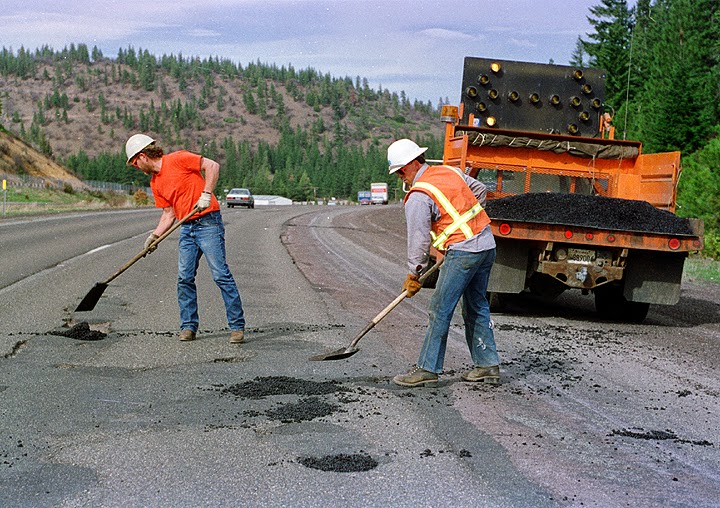
| Highway crews in California fill in potholes as a temporary measure until a long-term fix can be done. This photo comes from the California Department of Transportation. |
Many in-house
patches are methods for TxDOT to hold a pavement together until the appropriate
construction project can be developed and implemented. These projects require clear, dry weather for a stretch of several days, or the project will be nullified by the wet and less-stable material.
GA: What can be done to provide a more lasting fix for the potholes we’re
seeing?
PB: TxDOT is, and has been, a national leader in innovative techniques
and materials. Because of TxDOT efforts pothole repair materials have actually gotten
better over time. For example, historically patching material was only able to
be obtained in bags or containers to keep light-end oils in the material
allowing it to stay workable. Through partnerships within the industry, TxDOT has
developed a patching material that can be stockpiled for 6 months and still
maintain its workability. This has enable larger patches to be addressed and
perform longer.
GA: Is there a roadway material we can use that won’t see potholes? If
so, why aren’t we using it?
PB: Any material
used on a highway will ultimately encounter varying environmental, traffic, and
construction impacts - all of which can have an impact on the roadway’s ability
to resist potholes. Unfortunately, because each one of these
elements is very dynamic, it’s virtually impossible to prevent all the
variables from never causing a pothole.
There are materials and pavement structures that are more resistant
to the formation of potholes than traditional asphalt, but TxDOT has a responsibility to taxpayers
to ensure all roadways are engineered to provide an adequate functional performance. In addition to potholes, TxDOT evaluates rutting,
longitudinal cracking, alligator cracking, spalling, and punchouts.
Functional characteristics can include smoothness, raveling (what folks have seen through February on U.S. 281 near Hildebrand), and flushing. Each
one of these characteristics are considered along with the amount of traffic,
weights, and environment to develop a pavement system that will function
accordingly. To only design a road to account for potholes is not sufficient.
![]() |
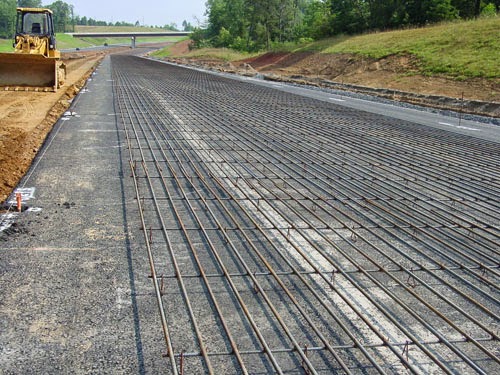
| Continually reinforced concrete roadways are one option to reduce pothole occurrence, but they are too costly to be feasible in south-central Texas. |
In addition, if TxDOT were only to select materials that were
highly resistant to potholes, a fiscal inequity would develop. For example,
continuously reinforced concrete pavement (CRCP) may be considered a material
that is more resistant to potholes than a thin layer of asphalt and rock (seal
coat), but because CRCPs unit price and quantities are so much higher than a
seal coat it is difficult to justify and prevent other roadways from being maintained or expanded.
Monday, January 12
Why brine solution?
Though this blog is dedicated to updates on active construction projects, periodically we are asked some pretty good questions that deserve more of a response than 140 characters will afford.
Over the weekend's weather event, we were asked why we don't use salt to eliminate and protect against ice, as transportation departments in northern states use. Some of those asking suggest we might be able to avoid closing the highway or highway interchanges if we were to use salt. Those asking hail from northern states and have seen ice and snow events much worse than what we encountered over the weekend, and the claim is that those events up north don't shut down the highways like our events do.
The truth is, even northern states are starting to switch over to saltwater brine. According to one report, salt chat only works on ice that's already been formed and only when temperatures remain above 15 degrees Fahrenheit. The New York State Department of Transportation has opted to switch to brine solutions as a proactive measure, citing brine as more effective than salt chat.
Brine is an anti-icing saltwater solution with a salt concentration of about 23 percent. At that concentration, the freezing temperature of water sinks to about zero degrees Fahrenheit. Brine is applied at rates adjusted for anticipated weather conditions ranting between 30 and 60 gallons per lane mile.
The brine helps create a barrier between the ice and the roadway, stopping ice from bonding to the road or, in the case of south Texas, from forming in the the first place. This proactive approach is among the most cost-effective (and environmentally safe) practices in winter road maintenance.
Just how cost-effective is saltwater brine? Even in 1995, the Iowa DOT produced a document describing the cost savings of using saltwater brine in tandem with salt chat, observing that saltwater brine isn't effective when snow and ice build up over a period of time - not an issue in south Texas.
Perhaps most interestingly, the Iowa report shows a cost breakdown of roughly 5 cents per gallon of brine and about $30 per ton of salt chat. Using just one or just the other, that means the same lane mile would run roughly $3 either way; no real financial gain. For Iowa, though, the use of saltwater brine reduced the need for salt chat by some 25 percent (the brine prevents salt chunks from bouncing off the roadway, being wasted). The result is a cost-per-mile of roughly $2.25 using a combination of brine and salt.
But those numbers are old - 1995 was a long time ago (20 years!), and salt chat prices are dramatically on the rise. A Michigan report from November tells of the cost of salt rising by more than 40 percent this year, landing at $65.81 per ton (average). Other states are reporting costs in excess of $100 per ton. That means your average lane-mile of roadway would run between $6.60 and $12 to treat with salt alone. The brine solution for the same stretch? About $4 (about 6 cents per gallon). None of that includes the delivery fees, of course, driving the price on all items upward.
There are additional costs to consider as well. For starters, salt chat would need to be stored somewhere, and those storage places would need to be climate controlled to a degree (salt dissolves in warm water that would come in south Texas rain storms). What's more, these storage areas would need to be built in the area, where they're not currently existing. Once built, there are maintenance costs to consider.
The box spreaders we would need for salt chat are indeed in our inventory, but to make the most out of our salt we would likely need something other than what we now have. There are more efficient spreaders in the industry that claim to reduce wasted salt (again, bouncing off the roadway or scattering away from the travel lanes), but those machines come at a hefty price added price - one we couldn't afford for equipment that may well sit, unused, some 48 weeks of the year.
For brine, we actually use the same spray trucks crews use during the summer to spread herbicide and don't require additional attachments for more efficient spreading. TxDOT is considering the purchase of special equipment that would allow the brine to be made on-site, but that equipment is much less expensive than the spreader boxes needed for the salt chat. The brine-making tanks would reduce the price of brine by more than 95 percent. Making the brine on-site would also completely eliminate the need for long-term storage.
Meanwhile, TxDOT continues to use other means of protecting prepared drivers from the perils of winter driving. We do use rock chat on select areas prone to black ice (particularly overpasses or bridges in the hill country) where low traffic volumes mean less friction on the roadway surface and lower road surface temperatures. We use magnesium chloride where deemed appropriate. In northern portions of the state, where snow or ice buildup is indeed possible, we do use salt and sand mixes.
But in the San Antonio area, we're looking for the most cost-effective way to treat a roadway for a light icing. Saltwater brine seems to fit that bill and is emerging as a frontrunner in solutions for this issue. Will it guarantee our roads remain open all year long? No - we did close a number of roadway segments Saturday morning. But those closures were as precautionary as they were temporary, and we had every road lane available for use within about six hours.
Not too bad for a group that can count on one hand the number of ice events we see during a year.
Over the weekend's weather event, we were asked why we don't use salt to eliminate and protect against ice, as transportation departments in northern states use. Some of those asking suggest we might be able to avoid closing the highway or highway interchanges if we were to use salt. Those asking hail from northern states and have seen ice and snow events much worse than what we encountered over the weekend, and the claim is that those events up north don't shut down the highways like our events do.
The truth is, even northern states are starting to switch over to saltwater brine. According to one report, salt chat only works on ice that's already been formed and only when temperatures remain above 15 degrees Fahrenheit. The New York State Department of Transportation has opted to switch to brine solutions as a proactive measure, citing brine as more effective than salt chat.
Brine is an anti-icing saltwater solution with a salt concentration of about 23 percent. At that concentration, the freezing temperature of water sinks to about zero degrees Fahrenheit. Brine is applied at rates adjusted for anticipated weather conditions ranting between 30 and 60 gallons per lane mile.
The brine helps create a barrier between the ice and the roadway, stopping ice from bonding to the road or, in the case of south Texas, from forming in the the first place. This proactive approach is among the most cost-effective (and environmentally safe) practices in winter road maintenance.
Just how cost-effective is saltwater brine? Even in 1995, the Iowa DOT produced a document describing the cost savings of using saltwater brine in tandem with salt chat, observing that saltwater brine isn't effective when snow and ice build up over a period of time - not an issue in south Texas.
Perhaps most interestingly, the Iowa report shows a cost breakdown of roughly 5 cents per gallon of brine and about $30 per ton of salt chat. Using just one or just the other, that means the same lane mile would run roughly $3 either way; no real financial gain. For Iowa, though, the use of saltwater brine reduced the need for salt chat by some 25 percent (the brine prevents salt chunks from bouncing off the roadway, being wasted). The result is a cost-per-mile of roughly $2.25 using a combination of brine and salt.
But those numbers are old - 1995 was a long time ago (20 years!), and salt chat prices are dramatically on the rise. A Michigan report from November tells of the cost of salt rising by more than 40 percent this year, landing at $65.81 per ton (average). Other states are reporting costs in excess of $100 per ton. That means your average lane-mile of roadway would run between $6.60 and $12 to treat with salt alone. The brine solution for the same stretch? About $4 (about 6 cents per gallon). None of that includes the delivery fees, of course, driving the price on all items upward.
There are additional costs to consider as well. For starters, salt chat would need to be stored somewhere, and those storage places would need to be climate controlled to a degree (salt dissolves in warm water that would come in south Texas rain storms). What's more, these storage areas would need to be built in the area, where they're not currently existing. Once built, there are maintenance costs to consider.
The box spreaders we would need for salt chat are indeed in our inventory, but to make the most out of our salt we would likely need something other than what we now have. There are more efficient spreaders in the industry that claim to reduce wasted salt (again, bouncing off the roadway or scattering away from the travel lanes), but those machines come at a hefty price added price - one we couldn't afford for equipment that may well sit, unused, some 48 weeks of the year.
For brine, we actually use the same spray trucks crews use during the summer to spread herbicide and don't require additional attachments for more efficient spreading. TxDOT is considering the purchase of special equipment that would allow the brine to be made on-site, but that equipment is much less expensive than the spreader boxes needed for the salt chat. The brine-making tanks would reduce the price of brine by more than 95 percent. Making the brine on-site would also completely eliminate the need for long-term storage.
Meanwhile, TxDOT continues to use other means of protecting prepared drivers from the perils of winter driving. We do use rock chat on select areas prone to black ice (particularly overpasses or bridges in the hill country) where low traffic volumes mean less friction on the roadway surface and lower road surface temperatures. We use magnesium chloride where deemed appropriate. In northern portions of the state, where snow or ice buildup is indeed possible, we do use salt and sand mixes.
But in the San Antonio area, we're looking for the most cost-effective way to treat a roadway for a light icing. Saltwater brine seems to fit that bill and is emerging as a frontrunner in solutions for this issue. Will it guarantee our roads remain open all year long? No - we did close a number of roadway segments Saturday morning. But those closures were as precautionary as they were temporary, and we had every road lane available for use within about six hours.
Not too bad for a group that can count on one hand the number of ice events we see during a year.
Subscribe to:
Posts (Atom)